
markel vigo

I'm interested in AI supported decision-making in data-intensive environments such as physical activity tracking and interactive dashboards. I use mixed methods approaches to gain deeper insights into human behaviour when interacting with such systems. This involves leveraging human-centred methods, tools and pipelines that isolate behavioural patterns that feed into computational user models of usability, engagement, and knowledge acquisition.
Currently, I focus on two areas. First, within healthcare, I investigate the implementation of eXplainable AI to support critical decision-making in environments such as the ICU, clinical dashboards, and health tracking applications. Second, I explore the role of AI in the workplace to enhance workforce learning opportunities, well-being and performance.
I received a PhD in Computer Science from the University of the Basque Country about web accessibility assessment, evaluation and measurement. I keep active in the accessibility field and publish papers about:
- Scoping and defining web accessibility;
- The perception of web accessibility by professionals;
- The limitations of automated accessibility evaluation tools;
- The role of expectations on user testing;
- and more recently we empirically analysed the relationship between user experience and web accessibility.
LATEST NEWS
October 2021 I received a Turing Fellowship. My 'spotlight' talk can be watched in Youtube and the slides are also available.
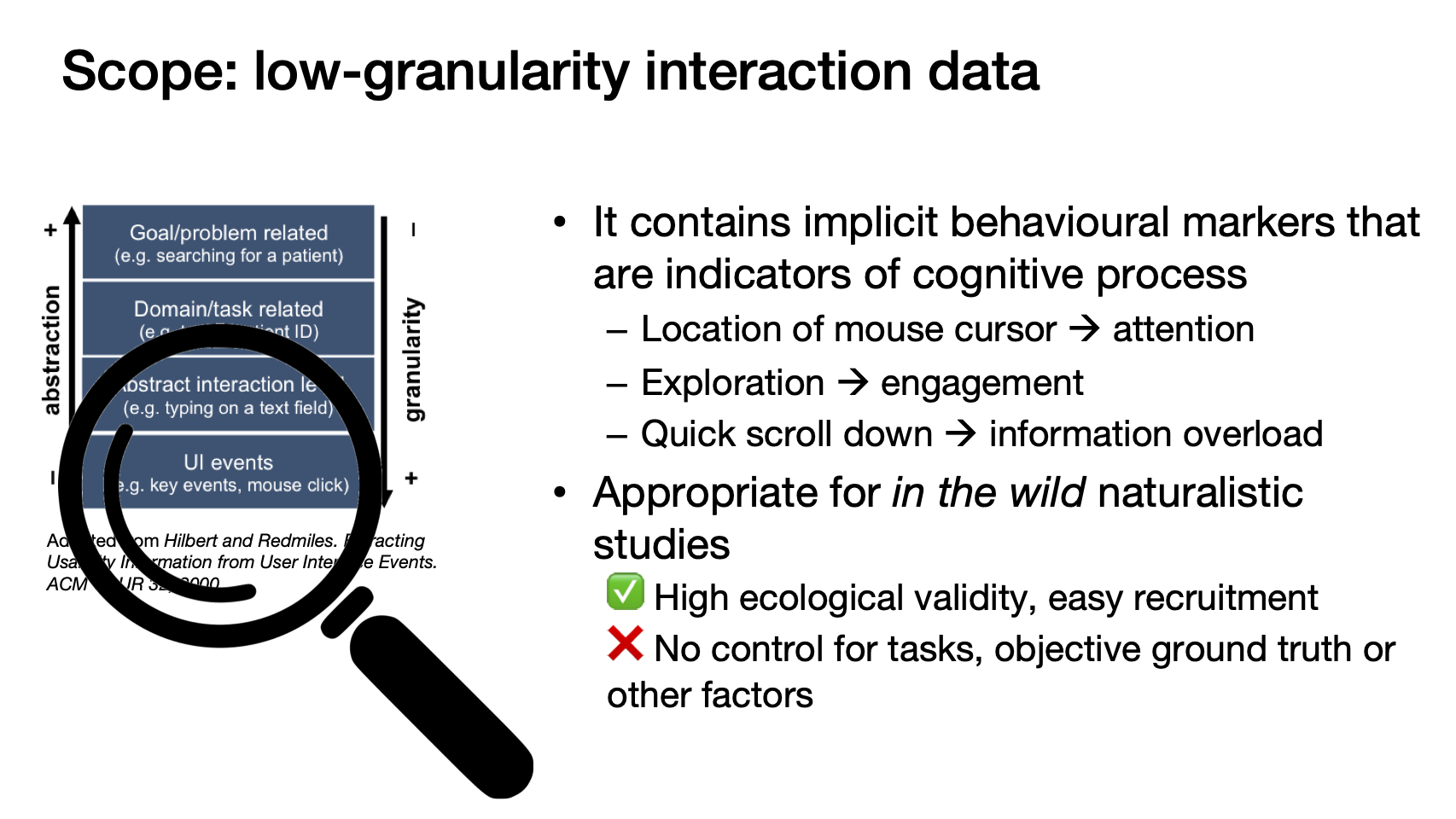
User interaction analysis is key to understanding the interface between humans and interactive computing systems. Despite being an essential activity for digital phenotyping and user modelling purposes, the manipulation, enquiry and mining of interaction data is full of challenges.
Informed by case studies on online learning, knowledge acquisition and user interface evaluation, in this talk I'm going to: (1) introduce a set of tools to support hypothesis-driven and data-driven analysis; and (2) present some innovative data analysis pipelines that involve human decision-making.